

The Revision Strategy That Actually Works for FMGE
If you ask students who successfully clear FMGE one simple question:
"What was the most important part of your preparation?"
Most of them give the same answer.
Revision.
Not lectures.
Not new notes.
Not endless resources.
Just structured revision done repeatedly.
The FMGE exam tests your ability to recall information instantly under pressure.
And recall only improves through systematic revision cycles.
Students who revise their notes multiple times almost always perform better than students who only read the syllabus once.
That is why top FMGE performers usually follow a structured revision system.
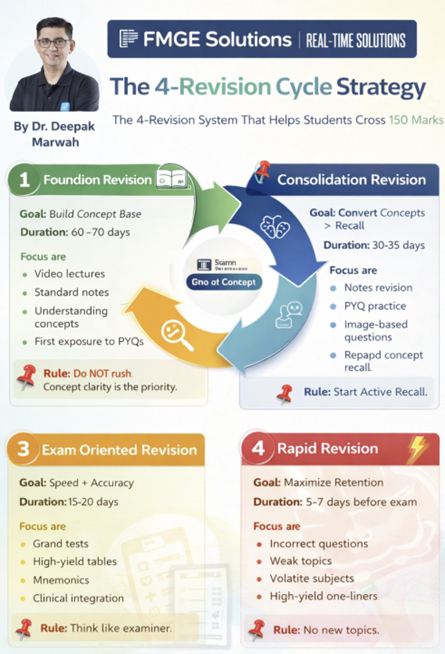
One of the most effective methods is the 4-Revision Cycle Strategy.
Why Revision Matters More Than First Reading
Medicine is a vast subject.
But the human brain is not designed to remember everything after a single reading.
Research on memory shows something very interesting.
Without revision:
But each revision strengthens memory pathways.
The more times you revisit a concept, the easier it becomes to recall during the exam.
This is why successful FMGE aspirants focus less on covering more content and more on revising the right content repeatedly.
The 4-Revision System for FMGE Preparation
A powerful revision system that works extremely well for FMGE is the 4-revision cycle.
This method combines spaced repetition, active recall, and MCQ reinforcement.
After studying a topic, the first revision should happen quickly.
Ideally within 48–72 hours.
At this stage your goal is simple.
Refresh the concept before it fades.
This revision is usually short and quick.
Focus on:
This helps consolidate the initial memory.
The second revision happens within one week.
At this stage you should add active recall.
Instead of only reading notes, challenge your brain.
Ask questions like:
Active recall strengthens memory dramatically.
You can explore this technique further in our guide:
Active Recall Strategy for FMGE
By the third revision the topic becomes more familiar.
This stage should combine:
MCQs convert knowledge into exam-ready thinking.
Students often notice a big improvement in accuracy during this stage.
The fourth revision is where memory becomes long-term recall.
At this stage focus on:
Speed becomes important here.
FMGE requires answering 300 questions efficiently.
Fast recall can make a huge difference.
Example of the Revision Cycle
Example topic: Beta blockers
Day 1 – Study the concept
Day 3 – First quick revision
Day 7 – Active recall questions
Day 15 – MCQs and error review
Day 30 – Rapid high-yield revision
After four cycles the concept becomes almost automatic.
This is exactly the level of recall required in the FMGE exam.
Focus Your Revision on High-Yield Topics
Another key principle is prioritization.
Not every topic deserves equal revision time.
Focus on areas that repeatedly appear in FMGE such as:
You can explore these topics in detail in our guide:
FMGE High-Yield Topics That Decide Whether You Pass or Fail
The Importance of Using One Structured Resource
One mistake many FMGE aspirants make is using too many resources.
During revision this creates confusion.
Instead of revising quickly, students waste time switching between:
Successful candidates usually rely on one structured revision source.
Many students prefer using FMGE Solutions because it compiles high-yield exam patterns into a revision-friendly format that allows faster review before the exam.
Students who implement the 4-revision system often notice three major improvements.
When concepts are revised repeatedly, they become automatic responses.
This makes a huge difference during a 300-question exam.
A Simple Daily Revision Routine
Here is a practical example of how to include revision in your day.
Morning (3 hours)
Major subject revision
Afternoon (3 hours)
MCQs and active recall
Evening (2–3 hours)
Short subject revision
Night (30 minutes)
Rapid review of previously studied topics
This structure keeps concepts fresh without overwhelming the brain.
Final Thoughts
FMGE preparation is not about reading the syllabus once.
It is about building strong memory through structured revision.
The students who cross the 150-mark passing score are usually the ones who revise their notes repeatedly.
If you combine:
your chances of success increase dramatically.
And when the result day arrives, the countless hours of revision will finally turn into the word every FMG doctor is waiting to see.
PASS.
FAQs
How many revisions are required for FMGE?
Most successful candidates revise their notes four to six times before the exam.
What is the best revision strategy for FMGE?
A combination of spaced repetition, active recall, and MCQ practice works best.
When should revision start during FMGE preparation?
Revision should begin within 2–3 days of first studying a topic.
About the Author
Dr Deepak Marwah is a medical educator and mentor for FMGE and NEET-PG aspirants. Through MedNext offline coaching academy program and structured resources like the FMGE Solutions book, he has helped thousands of students simplify medical subjects and improve exam performance.
Subscribe Our YouTube Chanel for Free video Classes by Dr. Deepak Marwah https://www.youtube.com/channel/UCoAYFoo-JiFp0l2iwrCUGAg
India’s Best Coaching Institute for FMG Exam by Dr. Deepak Marwah and Team