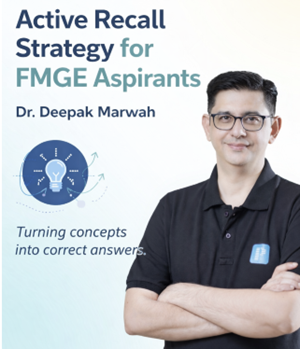
Active Recall Strategy for FMGE: The Study Method That Turns Average Students into Top Scorers

The Most Painful FMGE Realization
Many FMGE aspirants experience the same heartbreaking moment.
You finish reading an entire subject.
You feel confident.
You feel prepared.
Then you start solving MCQs.
And suddenly something strange happens.
You cannot remember what you studied.
Concepts that felt clear yesterday suddenly feel unfamiliar.
You begin to panic.
Did I actually study this?
Why can’t I recall the answer?
This moment is extremely frustrating.
But it reveals an important truth about FMGE preparation.
Most FMGE students do not fail because they are weak. They fail because they study in a way the brain does not remember.
Simply reading Notes for 8 Hours a Day Is Giving You False Confidence
Reading is not learning.
Most students believe they are studying when they are actually just recognizing information.
The brain says:
“Yes, I have seen this before.”
But the exam requires something very different.
It requires recalling information without seeing it first.
And that is exactly where most FMGE aspirants struggle.
The Secret Behind Students Who Clear FMGE
If you analyse students who clear FMGE consistently, you will notice one common pattern.
They do not just read notes repeatedly.
They practice active recall.
Active recall is a scientifically proven learning technique where the brain is forced to retrieve information from memory.
Instead of passively reading your notes, you challenge yourself to answer questions without looking at the material.
This simple change dramatically improves memory retention.
Studies in cognitive psychology show that active recall can improve long-term retention by more than 50%.
That is why this method is used by:
  • medical toppers
  • competitive exam rankers
  • memory champions
And it works extremely well for FMGE preparation.
What Is Active Recall?
Active recall simply means testing your memory instead of rereading information.
But the exam does not work like that.
For example:
Passive study method:
Read a page about myocardial infarction again and again.
Active recall method:
Close the book and ask yourself:
  • What are the ECG changes in MI?
  • What is the drug of choice?
  • What are the complications?
By forcing the brain to retrieve the answer, you create strong neural connections.
This makes the information easier to recall during the exam.
Why Passive Reading Fails in FMGE
Most FMGE aspirants prepare using a passive study method.
They read:
  • notes
  • coaching material
  • textbooks
They highlight important lines.
They feel productive.
But during the exam something unexpected happens.
They cannot recall the information.
This happens because passive reading creates recognition memory, not recall memory.
Recognition memory works like this:
You see the answer and think:
“Yes, I remember this.”
But FMGE requires recall memory:
You must produce the answer without seeing it first.
That is why passive reading alone is rarely enough to clear the exam.
The Active Recall System for FMGE Preparation
To apply active recall effectively, you need a structured system.
Here is a powerful method used by successful FMGE candidates.
Step 1: Read Once, Recall Immediately
Start by reading a topic normally.
For example:
Acute myocardial infarction.
After reading the topic once, close the book.
Now ask yourself:
  • What are the diagnostic ECG changes?
  • What is the drug of choice?
  • What complications occur?
Write the answers on paper.
Then open the book and check what you missed.
This simple process strengthens memory dramatically.
Step 2: Turn Your Notes Into Questions
Instead of writing notes as statements, convert them into questions.
Example:
Instead of writing:
“Streptococcus pyogenes causes rheumatic fever.”
Write:
“What organism causes rheumatic fever?”
Your brain now actively searches for the answer.
This improves retention significantly.
Step 3: Use MCQs as Recall Tools
MCQs are one of the best forms of active recall.
Every MCQ forces your brain to retrieve information.
But many students make a mistake.
They solve MCQs only after finishing the subject.
A better strategy is to solve MCQs immediately after studying a topic.
This helps reinforce memory.
Step 4: Teach the Concept
Teaching is one of the most powerful forms of active recall.
After studying a concept, explain it out loud as if you are teaching a junior student.
If you cannot explain something clearly, it means your understanding is incomplete.
Teaching exposes knowledge gaps quickly.
Step 5: Use Spaced Repetition
Active recall works best when combined with spaced repetition.
Instead of revising everything in one week, revise topics at increasing intervals.
Example:
Revision schedule:
  • Day 1
  • Day 3
  • Day 7
  • Day 15
  • Day 30
Each revision strengthens memory further.
This is why spaced repetition is extremely effective for medical exams.
Example of Active Recall in FMGE Subjects
Let us see how active recall works in real subjects.
Pharmacology Example
Topic: Beta blockers
Active recall questions:
  • What is the mechanism of action?
  • Which beta blocker is cardio-selective and cannot be given in bradycardia
  • What are the contraindications?
  • What are the adverse effects?
Answering these questions from memory improves retention.
Microbiology Example
Topic: Staphylococcus aureus
Recall questions:
  • Which toxin causes toxic shock syndrome?
  • What culture media is used?
  • What diseases does it cause?
This technique converts memorization into active thinking.
Pathology Example
Topic: Tumor markers
Recall questions:
  • Which marker is seen in hepatocellular carcinoma?
  • Which marker increases in pancreatic cancer?
  • Which tumors produce AFP?
Answering these improves exam recall.
Why Active Recall Works So Well for FMGE
FMGE is a pattern recognition exam.
Most questions test whether you can:
  • recall key concepts
  • eliminate incorrect options
  • identify clinical clues
Active recall trains your brain to perform exactly these tasks.
That is why students using this method often perform better in MCQs.
The Emotional Truth About FMGE Preparation
FMGE preparation is not just an academic challenge.
It is an emotional journey.
Many students face:
  • repeated attempts
  • financial stress
  • fear of failure
  • pressure from family
At times it feels like the effort is endless.
But the students who succeed are not always the most intelligent.
They are the ones who develop better study systems.
Active recall is one of the most powerful systems you can adopt.
Combine Active Recall with High-Yield Topics
Active recall becomes even more powerful when applied to high-yield FMGE topics.
Instead of recalling everything, focus on concepts that frequently appear in the exam.
You can read about these in our guide:
FMGE High-Yield Topics That Decide Whether You Pass or Fail
This strategy ensures your effort is focused on the most important areas.
Active Recall for FMGE Repeaters

Active recall is one of the most powerful systems you can adopt.

If you are preparing for FMGE again after a previous attempt, active recall can completely transform your preparation.
Many repeaters fail because they rely on passive reading.
Switching to active recall forces the brain to strengthen memory pathways.
This leads to faster revision and better exam performance.
You can also read our detailed guide on:
FMG Study Plan for Repeaters
Final Thoughts
FMGE preparation often feels overwhelming.
The syllabus is vast.
The pressure is intense.
But the difference between failure and success often lies in how you study, not just how much you study.
Active recall transforms your brain from a passive reader into an active problem solver.
And that is exactly the skill required to clear FMGE.
If you begin using this method consistently, your memory will improve, your revision will become faster, and your confidence will grow.
And one day, when you finally see the word PASS next to your name, you will realize that every hour of effort was shaping the doctor you were meant to become.
FAQs
What is active recall in FMGE preparation?
Active recall is a study method where you test your memory by recalling information without looking at notes.
Is active recall better than rereading notes?
Yes. Research shows active recall improves memory retention far more than passive rereading.
How often should I use active recall?
Ideally every day during your FMGE preparation.
Use it while revising topics and solving MCQs.
About the Author
Dr Deepak Marwah is a medical educator and mentor for FMGE and NEET-PG aspirants. Through MedNext offline coaching academy and online teaching platforms, he has helped thousands of students improve their exam strategy and achieve success. He has authored FMGE Solutions book which is a recall-friendly revision tool for the last decade.
Subscribe Our YouTube Chanel for Free video Classes by Dr. Deepak Marwah https://www.youtube.com/channel/UCoAYFoo-JiFp0l2iwrCUGAg
India’s Best Coaching Institute for FMG Exam by Dr. Deepak Marwah and Team
Links of must watch videos of this channel
Share this post -